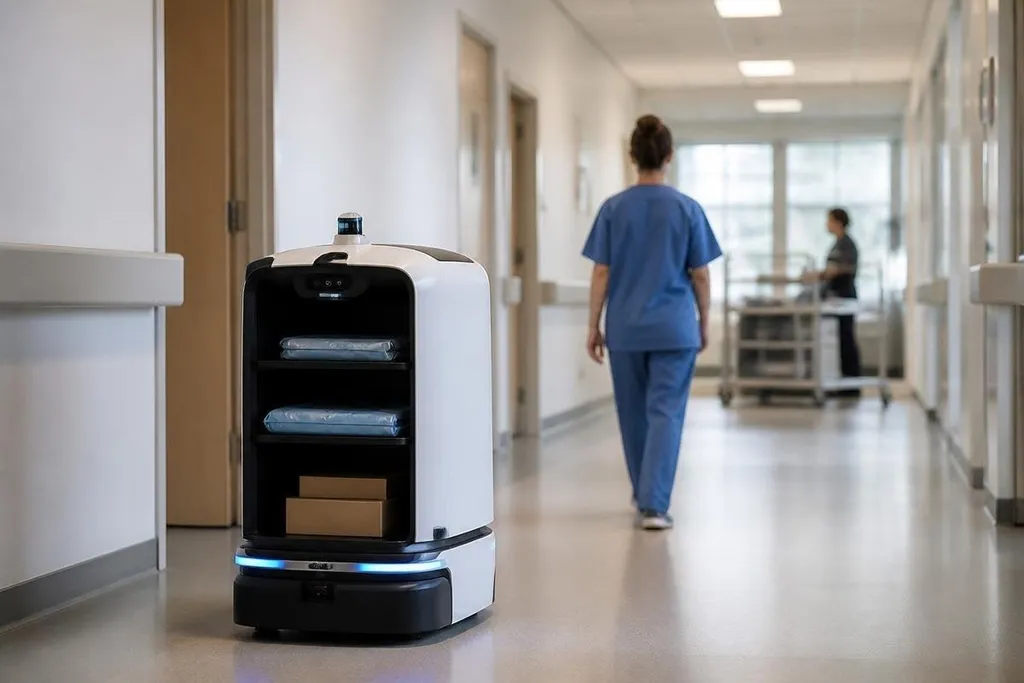
A hospital robot won’t replace a nurse, porter, or cleaner. It can take a repeated task off their list, which may leave more time for work that needs a trained person.
The useful question is narrower: which jobs can a robot do safely, for long periods, without adding more work for staff?
- Robots can move supplies, meals, linens, and waste along set routes.
- Software can sort requests and send tasks to the right team.
- Patient-facing robots need close checks for safety, privacy, and trust.
Moving items through the building
A large hospital moves many items between storage rooms, wards, laboratories, pharmacies, and operating areas. An autonomous mobile robot, or AMR, uses sensors and maps to travel through set spaces without a person steering it at every turn.
That makes internal transport a practical place to start. A robot can carry a sealed box of supplies, request an elevator, stop at a ward, and report that the delivery is complete. Staff still decide what goes into the box and where it must go.
The limit is the building. Doors, lifts, narrow corridors, visitors, beds, and cleaning carts all create problems for a machine designed around fixed routes.
Before that works, the hospital may need door controls, lift access, charging points, and marked handoff areas so the robot can run safely.
A robot also needs a clear answer when its route is blocked. Sending a nurse to rescue it turns a labour-saving task into another call on a short-staffed team.
Taking routine work away from clinical teams
Some hospital work is physical but does not require a clinical decision. Robots could move linen, collect waste, restock common items, or bring equipment to a treatment room. Each task still needs rules for infection control, cleaning, and handover.
The useful measure is not the number of robots in a building. It is the staff time returned after charging, cleaning, route checks, and fault handling are counted. A robot that makes ten trips but needs a person beside it for nine has a different value from one that completes those trips alone.
Hospitals should also check the task during busy periods. A corridor that looks clear at 2 a.m. may hold beds, visitors, and staff at noon. Robot speed matters less than safe movement around people.
The staffing case depends on the work a robot can take on without adding new checks. Hospital robotics reports from Robot24.com can tie each claim to a named machine and a recorded trial, then show which staff tasks remain when patients need information or requests answered.
Helping with information and requests
Not every useful hospital robot has wheels. Scheduling software, inventory tools, and room-status systems can reduce calls between departments when they connect to the hospital’s existing records.
A system could show which rooms are ready, where equipment is stored, or which request has waited longest. It must show the source and age of that information, because a wrong status can send staff to the wrong place.
Patient-facing robots need a higher bar. A machine that gives directions or carries a video call may help people find a clinic or speak with a relative. It should make clear when a person is unavailable, and it must offer a simple route to human help.
Privacy needs the same care. Cameras and microphones should collect only what the task needs, with clear rules for storage, access, and deletion. A hospital cannot treat these questions as a later software setting.
What hospitals should check first
A small pilot can answer more than a polished demonstration if the team records the work around the robot. Use this checklist before buying or expanding a system:
- Name the task: count trips, waiting time, handoffs, and staff minutes across a normal shift.
- Map the route: record doors, lifts, narrow points, cleaning areas, and places where people stop.
- Set the safe state: define what the robot does when a sensor fails, a route closes, or a person blocks it.
- Count human work: include loading, charging, cleaning, monitoring, software checks, and recovery calls.
- Check the data: set rules for patient information, camera access, system logs, and deletion.
- Choose a measure: set a target such as fewer porter trips, shorter delivery waits, or more time for ward work.
The work robots should take first
The first hospital robot should handle a repeated task with a clear route, a simple handoff, and a result the team can measure. That points toward internal transport and stock movement before machines that speak with patients or make care decisions.
I’d start with one route and one shift, then expand only if the robot gives time back after its own costs are counted. Staff shortages make automation worth testing, but they don’t remove the need for staff judgment.